
Are you ready to give up teaching piano? Well, YouTube provides millions of free piano tutorials and lessons for your students. How can you compete with that? So don’t worry: your students won’t miss you!
Case in point: right now I’m sitting in one of my studios in a local music store. Just a few minutes ago, a young girl came in the store, sat down at a keyboard and ran through her repertoire, which apparently consists of “The First Four Bars of X” (where X= “Für Elise”, “Heart and Soul”, John Legend’s “All of Me”, that song – oh what is it called? – by Rihanna/Adele/Pink/Justin Bieber).
But if you’ve already clicked off this page to some article like “How to Heal When Robots Steal Your Job,” you’re missing out on this simple ninja secret:
Transform your greatest enemy into your greatest ally.
Yes, creative piano teacher, YouTube will become your greatest ally!
You don’t have to beat ‘em; and you don’t have to join ‘em. You don’t have to become a Synthesia master, punch out your alarm clock because you stayed up all night reading up on YouTube analytics, or rig up crazy marker boards behind your Yamaha model “blank” keyboard, or figure out how to run an overhead webcam.
You can keep teaching one-on-one or small groups in your in-person or online piano studio, be well paid, and transform the free resources on YouTube into your own personal assistant.
First, let’s see what you have to offer that YouTube doesn’t.
Do you use YouTube in your piano studio?
You already know that there’s a world of difference between what you do and what they do on YouTube. Let’s lay it out:
The overwhelming majority of YouTube tutorials are not posted by real piano teachers. As a consequence, they are full of misinformation, less-than-perfect technique, and jumbled learning steps.
As a real teacher, you know that each student presents their own unique bouquet of learning strengths, styles, and weaknesses – as well as personality and psychology. You understand the learning process, and can respond to the particular needs of your individual student.
You can respond and redirect in the moment to the actions, mind, and mood of your students. You can clear up an issue on the spot, and guide your students step by step through their learning.
You provide a comforting, warm, encouraging presence that supports your students in making it through whatever struggle they may be having. You express appreciation for their accomplishments.
And you are there to hold them accountable when they are not being responsible for their end of the deal.
Remember the “Four Measures of X” girl? While millions of videos offer “easy” ways to learn songs, most students are only able to decode snippets of these tutorials. They often think there’s something wrong with them when they can’t go beyond the first few measures.
Some even go as far as to sign up for piano lessons!
Combine these qualities with the vast resources available on YouTube and you have a truly winning combination that responds to the musical aspirations of today’s piano students.
Here are 10 ways you can fit this technology into your piano teaching:
I have discovered that many of my new students are already secret YouTube users. But most of them aren’t going to tell me!
They think that they come to piano lessons to learn what they should learn, then head on over to YouTube for what they want to learn.
I relish the look of surprise and fear in their eyes when – at the first lesson – I ask them what they’ve learned from YouTube. Then it requires a bit of coaxing for them to confess their guilty Synthesia pleasures.
And then – the amazement when it dawns on them that I can teach them the music they really want to play!
Learn more about first lesson strategies in my last post for Tim Topham.
There are many kinds of YouTube piano tutorials that all have their different uses. Let’s divide them into roughly four categories:
The most popular seem to be the piano roll types made by programs like Synthesia. These are most suited for rote learning of a song, and, later, transcription exercises. Every popular song under the sun seems to be available in this format.
These are very attractive to students, no doubt due to their resemblance to video games.
There are many tutorials of varying quality with live demonstrations and teaching of either full song arrangements, or of specific piano parts or pieces. Some videos merely slow things down, others go into more teaching and walking through.
Some are slickly produced, but often the low-tech examples can have better teaching.
While most students go for learning specific songs, general videos on chording, theory, scales, technique, improvisation and more are a very useful adjunct to your teaching. These videos can also help your students remember concepts in between lessons.
Naturally, the videos with the most visual stimulus often attract your students. As a perceptive piano teacher, you can guide your students in going beyond the bling and choosing the best tutorials for their learning step.
Every other music video on YouTube makes up the fourth category. (See below for some ideas.)
Your students want to play real music. Don’t we all?
Yes, you’ve come to know that scales and exercises are “good for you” and may even have come to enjoy them. But for your students’ sanity (and your own) please remember that day when your teacher first opened the Book of Hanon and ten thousand sixteenth notes blasted your eyes.
My goal is always to find the best way for my students to play the music they want to play as soon as possible. So to help them with YouTube I try to figure out the most fundamental skills
Whether they overtly explain it or (usually) not, most YouTube piano tutorial videos are chord-based. Even the melodies are more likely to be based on broken chords than scales.
I find that teaching students chords, inversions, and progressions goes a long way in helping them understand and decode YouTube tutorials. This can be done with diagrams and – yes – YouTube tutorials, even before a student can read music.
Imagine how much easier it will be for your student to learn this version of “Somewhere Over the Rainbow when she knows her chords:
The other most crucial missing link for YouTube success is technique. The technique on many YouTube videos is, well, less than perfect. You know that it will be easier to play this stuff with good technique. Maybe you can convince your students as well.
There are as many assumptions about the tutorial user’s previous knowledge as there are tutorials.
You come to this party with a much more complete picture. And it will be eye-opening for you to witness just where your student succeeds and where he gets stuck as he’s working through a tutorial.
What will make this learning easier? Good finger numbers? Chord knowledge? Breaking down the rhythms? Better technique?
Stay open to your own spirit of discovery when you are making these observations – you may surprise yourself with new ways of bundling together and teaching musical concepts.
These observations are invaluable in helping you design lessons that more directly address your student’s musical goals. And your students will be more motivated to learn these nitty-gritty concepts of theory and technique when they see them as stepping stones to playing the music they really want to play.
The overwhelming majority of YouTube tutorials eschew traditional notation for keyboard shots, a variety of idiosyncratic charts, tabs, and letters, or the dreaded Tetris-like piano roll churned out by Synthesia and similar programs.
This is very scary for us piano teachers. We have to surrender our main source of power, namely, “I know how to read music, and you don’t!”.
However, as a creative piano teacher, you know that the monumental task of learning to read traditional Western notation and translate it into playing the piano, can prevent students from expressing the full, rich, and satisfying music that their hands and brains are capable of playing.
YouTube, by definition, focuses on visual learning. Rhythm is mostly stripped away – the students already know the songs’ rhythm anyway. Note that all the alternate YouTube notation systems are focused on patterns, chords and actual piano keys.
One of the great advantages of notation is that you don’t have to memorize long pieces of music. Students are frustrated when they can’t remember more than a little bit of what they’re learning from a video. So you can bridge the gap with your own alternate notation.
Over the years I have come up with several ways to translate YouTube tutorials into a notation that is both reflective of the nature of the tutorial, and suited to the learning style and goals of the individual student. Often, these systems are based on a combination of keyboard diagrams labelled with finger numbers and a chart of the notes-by-number.
Here’s an example of the two measures starting at [0:14] in the video:
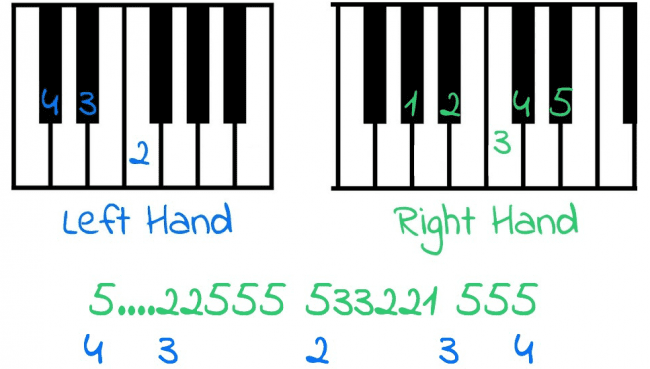
Sample of Alternate Notation for Synthesia Tutorial
This process can be somewhat laborious, but you’ll be surprised at how patient your students will be when the reward is playing that special song they’ve always wanted to play. And the students absorb so much simply by observing you in the process.
There are lots of opportunities here to teach pop polyrhythms by playing the hands off each other.
Related: 5 Ways to help Your Students Master Rhythm
You will find that once students have connected with the music visually and kinesthetically, you will be able to point out what these patterns look like in the written music. You may have to push a little, but they’ll catch on when they experience the dramatic improvement in their ability to read traditional notation.
Rhythm is often the most difficult part of transcription, especially the syncopated rhythms of today’s pop music.
Since the notes are provided, in piano roll videos, the student can focus on “translating” the graphic rhythmic notation into Western notation. For computer and laptop operating systems, YouTube has added a handy speed tool to make the process easier:
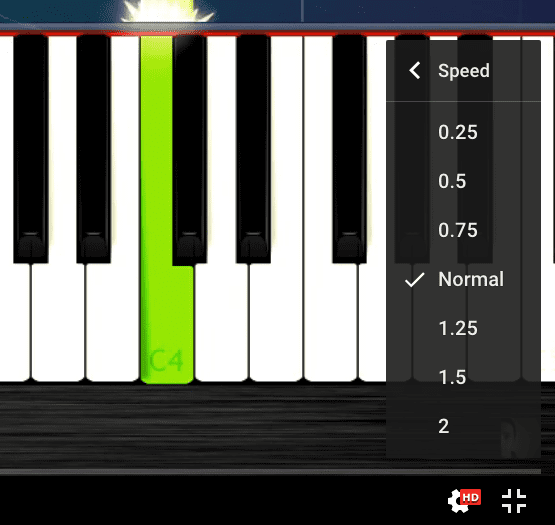
YouTube Speed Tool
From here, the transcription opportunities are endless.
There seems to be a piano tutorial available for every note of music ever made by humankind.
However, learning and figuring out your own arrangement from the original can be so much more rewarding. In fact, I actually have students who prefer to learn from the original.
A good foundation in chords and scales always helps here.
Students enjoy figuring out how they can approximate the sounds of other instruments on the piano, and learn a tremendous amount about tone color and dynamics in the process. I presently have one student who loves thrilling movie soundtracks. It’s a pleasure for both of us to figure out how to extract the orchestral colors of a Danny Elfman or Hans Zimmer soundtrack from the piano.
When students are hard-set on learning music beyond their ability levels, you are there to simplify if needed. And if the simplified arrangement in the video falls short of satisfying, you can add in a few chord tones or rhythms to challenge the student to make it sound better.
Either way, your students benefit from seeing you mess with the rote learning on the video. They learn by your example to accept their own authority in musical judgement, and grow the skills required to make the music they want to make.
Most of us piano teachers are relegated to the ridiculous paradigm of once-a-week lessons. Imagine if school children only did one math class, or one language arts class a week! And you deal with overscheduled students who would certainly be grateful if sports coaches were stuck in that once-a-week trap!
How much can we really expect our students to retain when they leave from our lesson to go to dance class then their brother’s football game, then up at the crack of dawn to spend a long day in school, followed by basketball practice, dinner, hours of homework… you get the idea.
Maybe they’ll get to practice in a couple of days.
Existing tutorials can help keep young pianists motivated during the week. Even better – grab your phone or tablet before the end of the lesson and make a few mini-tutorials focusing on specific songs.
I must have uploaded hundreds of these low-tech, mini-tutorials to my YouTube channel, purely with the intention of helping individual students in between lessons. And now the channel is pushing 70,000 views. A good reservoir should I decide to fold them into an online business venture.
Check out Tim’s podcast on this topic: Podcast Episode 9: Paul Harris on Simultaneous Learning
Like any technology, the ways in which YouTube can enhance our piano teaching are only limited by our own creativity. And, also like any technology, the effectiveness of YouTube depends on how it is used by humans.
Embrace this vast resource alongside your vast piano teaching resources you hold inside you, and you’re sure to invent even more fun and satisfying ways to help you and your students meet their musical goals.
Do you use YouTube in your teaching? Do you have any other tips? Please leave your suggestions and questions in the comments section below.