

It will be of little surprise to regular readers of this blog that composing, and it’s precursor activity, improvising, is high on my list of priorities for well-rounded music instruction.
With much of the focus of music lessons today being on reading, performance and examinations, students whose lessons are based solely on playing other people’s music are missing out on many of the skills required of a well-rounded pianist: being able to create music, play by ear, read lead sheets and improvise.
The ability to create music is one of the most important skills for students to develop.
It’s through creating music that students get a true appreciation for how music works, how it is constructed and how they can apply this to all the music they are studying.
It’s important to make sure we’ve got our language use right. For the purposes of my writing:
A piano composition in my studio may take just about any form (chordal, song/accompaniment, melodic, etc.), but needs to be repeatable and have a structure.
Do you encourage your students to compose music?
For the purposes of this month, I’ll be focussing more on non-jazz composing.
Many of you will be aware of my jazz and 12 bar blues resources, which lead students on a journey from complete newbie to basic jazz improviser. It’s perfect for any teachers new to this subject, so please check it out if you’re interested.
This month’s compositional focus is more about modern styles: contemporary piano solos, ballads, arrangements and pop-style composing, often based around chord progressions.
I find this is a highly-effective way to capture the attention, imagination and emotion of today’s students aged 10 or over, because it’s the basis of the music they’re already listening to, so it makes musical sense right from the beginning.
For students under 10, I tend to encourage creativity and composition through themes, motifs and analogies (see Approaches below) because that’s what I find captures their imaginations the most.
Musical creation has many benefits including:
If you’ve got teenage beginners, then this is the single most motivating activity you can do with them, right from the beginning.
And if you’ve got students who are on the borderline of quitting, then try this out – I’ve heard many teachers for whom this activity was the catalyst to a student turning a corner and continuing with lessons.
Another great reason to be able to work on composition with students is that it’s great if:
So why is composing not a more regular feature of piano lessons around the world?
Unfortunately, the process of individual music tuition on an instrument has changed little from the 1800s. Teacher suggests music, student begins to learn it, teacher corrects mistakes and provides modelling for interpretation, student applies learning and the process repeats.
The strange thing is that all the great composers were brilliant improvisers and arrangers – think Bach, Beethoven, Chopin and Liszt to name just a few.
It makes no sense to me that we ask students to play the written music of these masters without exploring how these masters came to write their pieces in the first place: improvisation!
While there will always be a place for performing written music, the imperative to “play it as written” is fast becoming irrelevant in today’s world.
Have a listen to this short clip of a speech by an internationally-renowned marketer, Seth Godin about the effect technology has had on the need for students to only learn to play things as written:
What students need now, more than ever, is an ability to be creative, to ask questions, to pose and solve problems and explore the unknown.
That’s what this blog and podcast is all about.
This whole website is dedicated to helping teachers approach teaching in a more creative manner, because I know it works.
Students love creating things and having ownership of their learning. They love working out why they like how a particular song sounds and trying to play ‘cool’ things that they hear.
They enjoy having a musical vocabulary of patterns and styles that goes beyond the music they are reading. They love exploring.
Best of all, it’s great fun and students will learn more from a fun, relevant, engaging activity than anything else in a music lesson.
What’s to lose?!
There are many approaches available to teachers for composing and there have been just as many books written about it.
Some approaches include:
It’s up to teachers to decide the way that suits them best. I personally like a chordal approach to start with (see 4 Chord Composing, below) and I know that others favour this method.
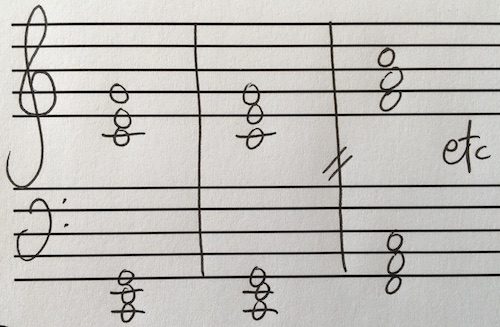
One place to start when composing music is with chords.
Other teachers like exploring themes and triggers like animals and countries of the world (see how I use this in my No Book Beginners method).
Whatever you choose, it’s great to have a variety of options up your sleeve as we know that all students are different.
One of the highlights of this month’s content on topmusic.co will be the release of my 4 Chord Composing Framework.
This is the method by which I most commonly introduce composing for students.
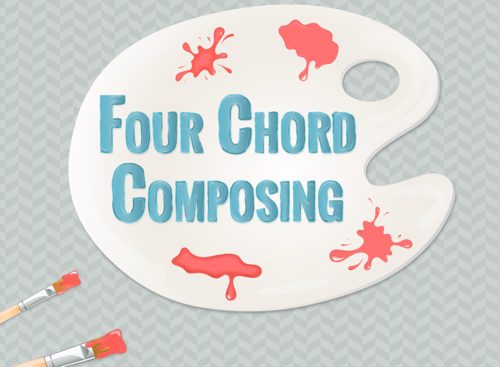
It’s is all about how teachers can use the “four chord” basis of pop music as a highly-motivational starting point for pop-style composition with their students.
I’ll be hosting a live webinar about this later in the month where I’ll demonstrate this process at the piano, as part of the launch of a full, step-by-step video course in the Inner Circle.
In addition, I’ll soon be releasing a companion course called “Grooving with GarageBand” which is a great way to bring this style of composing to life using technology.
Stay tuned for more information about this free training coming up later this month – it will be one you don’t want to miss!
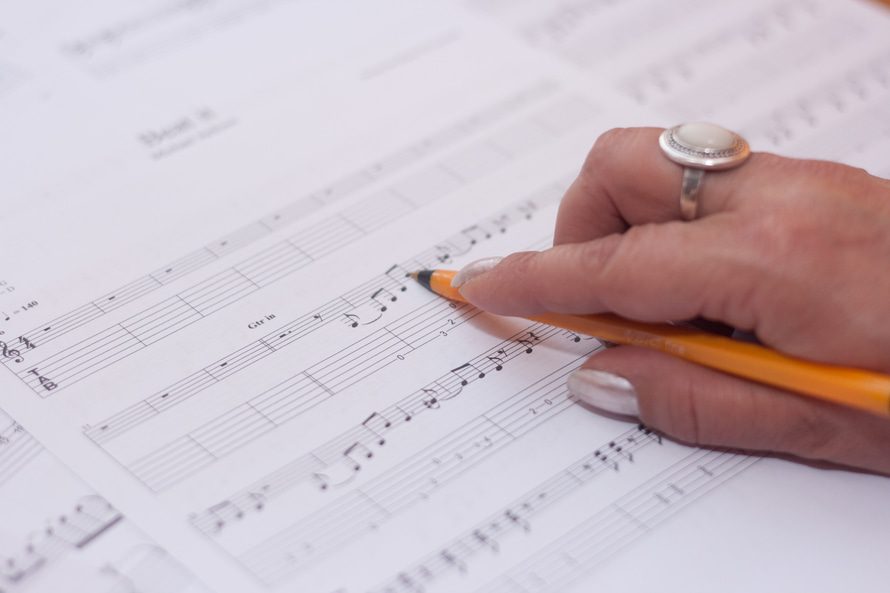
For the most part, I don’t request that students notate their compositions. While there’s nothing wrong with notation, this isn’t my primary objective.
For most people, and students in particular, notation is a time-consuming process. I’d much prefer for students to be “making notes” about their composition (in whatever form that takes) and spending more time exploring than trying to work out how to notate something precisely.
That said, some students love notating things (whether on paper or using software) and sometimes I feel that it’s important to encourage notation (eg. for publication or use in an audition, festival or exam).
All month we will be discussing composition on the blog and podcast. Here are some of the things you can look forward to…
August is dedicated to composition so please let us know in the comments section below if there’s a certain topic you would like us to address.
If you’ve never tried improvising or composing with students, then this is your month.
Set yourself the goal (yes, write it down!) of trying this out with at least one student and see how it goes.
You only need to get started in a small way to have a huge impact in a student’s life.
Looking forward to hearing about your progress. If you’ve got any questions or comments, please leave them below.
[thrive_posts_list category=’3693′ title=”” no_posts=”20″ filter=”recent” thumbnails=”on”]



Music Jamboree says:
Thanks for sharing, Tim! We have initiated an event to encourage our students to crEATe music.
With best wishes from Penang, Malaysia,
grace